As a trusted supplier of pneumatic rotary actuators, I understand the critical importance of accurately measuring the performance of these components. Our pneumatic rotary actuators are widely used in various industries, from automotive manufacturing to food processing, where precision and reliability are non – negotiable. In this blog post, I’ll share some key methods and factors to consider when measuring the performance of a pneumatic rotary actuator. Pneumatic Rotary Actuator
Understanding the Basics of Pneumatic Rotary Actuators
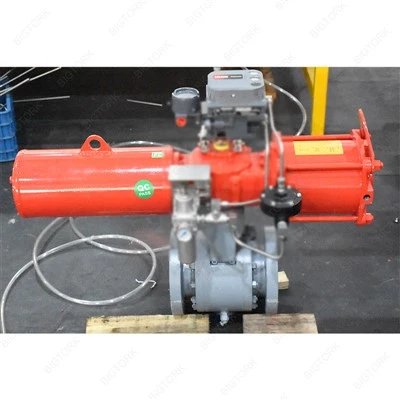
Before delving into performance measurement, it’s essential to have a clear understanding of what a pneumatic rotary actuator is. A pneumatic rotary actuator is a device that converts compressed air energy into rotational motion. It typically consists of a cylinder, piston, and gears that transfer the linear motion of the piston into a rotary movement.
The performance of an actuator can significantly impact the overall efficiency and productivity of a system. For example, in a robotic assembly line, a well – performing actuator ensures precise movement and reduces the chances of errors and wasted materials.
Key Performance Indicators (KPIs)
Torque Output
Torque is one of the most critical performance indicators for a pneumatic rotary actuator. It represents the force that the actuator can apply to rotate an object. Measuring torque accurately helps in determining if the actuator is suitable for a particular application.
To measure torque, we can use a torque sensor. A reaction torque sensor is commonly used in static applications, where the actuator is held in place, and the torque is measured as the actuator tries to rotate against the sensor. In dynamic applications, a rotary torque sensor can be used, which measures the torque as the actuator rotates at a specific speed.
The torque output of an actuator can vary depending on factors such as air pressure, the size of the actuator, and the load it is driving. It’s important to measure torque at different air pressures to understand how the actuator performs under various operating conditions.
Rotational Speed
The rotational speed of the actuator indicates how fast it can rotate. Measuring the rotational speed is crucial in applications where rapid and repetitive movements are required, such as in high – speed packaging machines.
A tachometer is a common tool for measuring rotational speed. There are contact and non – contact tachometers available. Contact tachometers require physical contact with the rotating shaft of the actuator, while non – contact tachometers use optical or magnetic sensors to measure the speed without direct contact.
The rotational speed of a pneumatic rotary actuator is influenced by air flow rate and pressure. Higher air flow rates generally result in faster rotational speeds, but it’s important to ensure that the actuator can handle the increased speed without compromising its durability.
Angular Accuracy
Angular accuracy refers to how precisely the actuator can rotate to a specific angle. In applications where exact positioning is required, such as in CNC machining or automated inspection systems, high angular accuracy is essential.
To measure angular accuracy, an encoder can be used. An encoder is a device that provides a digital or analog signal representing the angular position of the rotating shaft. By comparing the commanded angle with the actual angle measured by the encoder, we can determine the angular accuracy of the actuator.
Factors such as mechanical backlash, friction, and air leakage can affect the angular accuracy of the actuator. Regular maintenance and proper calibration can help minimize these issues.
Repeatability
Repeatability is the ability of the actuator to consistently produce the same output under the same input conditions. In manufacturing processes, high repeatability ensures that each product is produced with the same quality and specifications.
To measure repeatability, multiple tests are conducted under identical conditions. The actuator is commanded to perform the same rotational movement repeatedly, and the variations in torque, speed, and angular position are recorded. A statistical analysis can then be used to calculate the repeatability of the actuator.
Good repeatability is a sign of a well – designed and well – manufactured actuator. It reduces the need for frequent adjustments and improves the overall reliability of the system.
Environmental Factors and Their Impact on Performance
In addition to the internal factors that affect actuator performance, environmental conditions also play a significant role.
Temperature
Temperature can have a significant impact on the performance of a pneumatic rotary actuator. High temperatures can cause the air inside the actuator to expand, increasing the pressure and potentially causing damage to the components. On the other hand, low temperatures can make the seals and lubricants more rigid, reducing the efficiency of the actuator.
To measure the effect of temperature on performance, we can conduct tests in temperature – controlled chambers. Torque, speed, and accuracy measurements can be taken at different temperatures to understand how the actuator responds to temperature variations. Proper insulation and cooling systems can be implemented to mitigate the effects of extreme temperatures.
Humidity
Humidity can lead to corrosion and moisture buildup inside the actuator, which can affect its performance and lifespan. In high – humidity environments, it’s important to use actuators with corrosion – resistant materials and proper sealing.
We can measure the humidity in the operating environment using a hygrometer. If the humidity level is too high, dehumidification systems can be installed to protect the actuator. Additionally, regular inspections and maintenance can help detect and prevent any moisture – related issues.
Dust and Contaminants
Dust and contaminants in the air can enter the actuator and cause wear and tear on the moving parts. This can lead to reduced performance and premature failure of the actuator.
To measure the level of dust and contaminants in the operating environment, air quality sensors can be used. In dusty environments, it’s advisable to use actuators with protective covers and air filtration systems. Regular cleaning and replacement of filters can help maintain the performance of the actuator.
Testing Procedures
To ensure the overall performance of our pneumatic rotary actuators, we follow a comprehensive testing procedure.
Initial Inspection
Before testing, a thorough visual inspection is conducted to check for any obvious defects, such as cracks, leaks, or missing components. Any issues identified during the inspection are addressed before proceeding with the performance tests.
Static Testing
Static testing involves measuring the torque output of the actuator at rest. The actuator is fixed in place, and different air pressures are applied to measure the corresponding torque values. This helps us understand the actuator’s basic torque – pressure relationship.
Dynamic Testing
Dynamic testing is performed to measure the rotational speed and angular accuracy of the actuator under real – world operating conditions. The actuator is connected to a load and commanded to rotate at different speeds and angles. Encoders and tachometers are used to measure the actual speed and position, and the data is compared with the expected values.
Long – Term Testing
Long – term testing is crucial to assess the durability and repeatability of the actuator. The actuator is run continuously for an extended period, and its performance is monitored regularly. This helps us identify any potential issues that may arise over time, such as wear and tear or degradation of components.
Importance of Performance Measurement for Our Customers
Accurate performance measurement of our pneumatic rotary actuators is not only important for quality control but also for the benefit of our customers.
When customers understand the performance characteristics of our actuators, they can make more informed decisions about which product is best suited for their specific applications. By providing detailed performance data, we help customers optimize their systems and improve overall efficiency.

Moreover, in industries where safety is a top priority, such as aerospace and medical devices, reliable performance measurement ensures that our actuators meet the strictest safety standards. This gives our customers peace of mind knowing that they are using high – quality and reliable components in their products.
Contact Us for Your Pneumatic Rotary Actuator Needs
Hydraulic Actuator As a leading supplier of pneumatic rotary actuators, we are committed to providing high – quality products with excellent performance. Whether you are looking for an actuator for a small – scale project or a large – scale industrial application, we have the expertise and the products to meet your needs.
If you have any questions about the performance of our pneumatic rotary actuators or would like to discuss your specific requirements, please feel free to contact us. Our team of experienced engineers and sales representatives will be happy to assist you in finding the perfect solution for your application.
References
- Dixon, D., "Fluid Power with Applications". Prentice Hall, 2017.
- Murphy, D. F., "Pneumatic Systems Troubleshooting and Analysis". Industrial Press Inc., 2015.
- Thiel, R. L., "Rotary Actuators: Design, Applications, and Troubleshooting". McGraw – Hill Professional, 2014.
Zhejiang Bigtork Valve Automation Co., Ltd.
Zhejiang Bigtork Valve Automation Co., Ltd. is one of the leading pneumatic rotary actuator manufacturers and suppliers in China. We warmly welcome you to buy customized pneumatic rotary actuator at competitive price from our factory. Contact us for more details.
Address: 98 Yuanqu Avenue,Anfeng Industrial Zone,Oubei,Yongjia,Zhejiang,China.
E-mail: sales@bigtork.com
WebSite: https://www.bigtork.com/
