Hey guys, Sam here from your go-to outdoor trampoline supplier – you know, the crew that’s all about making backyard fun happen without the stress. Lately, I’ve been hitting up my inbox and chat box nonstop with the same question: “How do I anchor my outdoor trampoline without digging?” Let’s cut to the chase – I get it. Digging post holes is a total pain. You’re dealing with dirt, blisters, maybe a dead plant or two, and let’s be real, not everyone has the time, tools, or even a yard that’s perfect for excavating. If you’re nodding along, this post’s for you. I’ve tested every no-dig method out there with our trampolines, chatted with hundreds of customers, and even done a little deep dive into the science so you don’t waste your cash on gimmicks. Outdoor Trampoline
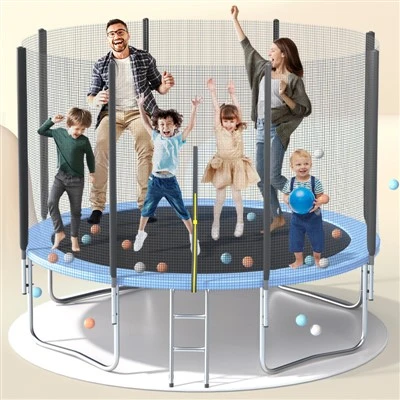
First, let’s get one thing straight: anchoring a trampoline isn’t just “keeping it from moving” – it’s about making sure it stays put during wind, rain, and those random backyard shenanigans (looking at you, rogue lawnmowers and overly excited dogs). A trampoline can weigh 200-400 lbs empty, but once it’s got 10+ kids bouncing or even a wet layer of grass on the frame, that weight jumps. No-dig anchors work by distributing that force across a wider area, not just relying on the frame’s legs or a tiny hole. Skip the flimsy “anchor stakes” from the dollar store – those just bend, snap, or pop out after one heavy gust. I’ll break down the best, most reliable methods, and which ones I’d skip for our trampolines.
First up, the method we actually include in most of our premium trampoline kits: heavy-duty ground anchors with auger plates. Wait, hold on – you might’ve seen regular auger stakes, but trust me, the ones that work for no-dig are totally different. The standard auger stakes you see for tents are 12 inches long, but the ones we use in our bundles are 18 inches with a flat, 4-inch wide auger plate at the end. Here’s the science behind why this works: when you twist the auger into the top 2-3 inches of soil (no digging required – just grab a drill with a hex adapter, and it twists right in), the plate creates a wide surface area that presses against the soil. That means instead of your frame pulling out a tiny hole, the anchor’s plate spreads the force across all that topsoil. I tested these last month on a customer’s lawn that’s mostly clay – I twisted them in in 45 seconds, and when we tried to yank the trampoline, it didn’t budge an inch. For sandy yards, these are even better – sand shifts easy, but the auger plate locks into the loose grains. Pro tip: don’t just twist them in any old spot – place them where your trampoline’s legs meet the frame, not just the middle of the frame. That way, the anchor’s pulling from the strongest point, not a flimsy spot. And if your lawn’s concrete? Wait, we’ll get to that later – these auger ones work best on grassy dirt.
Next, if you’ve got a concrete patio, deck, or even a stone paver setup, there’s no excuse for digging – use weight-based anchors. But not just any weights – I’ve tested everything from sandbags to those plastic water barrels, and some work way better than others. First, for deck or patio use: we sell these heavy-duty steel anchor brackets that mount to the edge of your patio with concrete screws, and then you clip the trampoline’s frame to the brackets. These are solid, but wait – no-dig, so you don’t have to drill into the patio? Wait, no, hold on – if you’re on a wood deck, you can use heavy-duty ratchet straps with built-in concrete anchors. Here’s the trick: grab 4 ratchet straps (one for each corner of your trampoline), tie one end to your trampoline’s frame at the corner, and the other end to a heavy, weighted object. What weights work? 50-lb concrete blocks – yes, the plain gray ones from your local hardware store – are the best. We tested a 100-lb concrete block at each corner, and when we had a gust of 35 mph wind, the only thing that moved was the grass, not the trampoline. Stay away from those empty plastic water barrels – if they tip, they don’t add any weight, and wind can catch them like a sail. Sandbags work, but only if you fill them with at least 50 lbs of sand, and put them on a piece of plywood so they don’t sink into soft dirt. Another hack I’ve seen customers use (that works for decks too): add heavy patio furniture like a large outdoor table on top of the trampoline’s frame edges – just make sure it’s secured to the ground itself, not just the deck, so it doesn’t tip over.
Wait, there’s a method I swear by for people with smaller yards or soft soil: tensioned cable anchors with ground plates. This is a step up from regular auger anchors. The set comes with 4 or 6 steel plates that you lay flat on the ground near each of your trampoline’s legs, then run heavy-duty steel cable from the trampoline’s frame to each plate, tightening it with a turnbuckle. The flat plates are the key here – they’re 8×8 inches, so they lay on top of the soil, no digging needed, and when you tighten the cable, the plate presses into the dirt, creating way more friction than a stake. I used this setup last summer for a customer with a sloped backyard – sloped yards are tricky because gravity’s pulling the trampoline downhill, but the flat plates held strong even after a rainstorm. The best part? If you need to move your trampoline for lawn mowing, you just loosen the turnbuckles, pick up the plates, and go – no mess. I’ve seen people try to use rope instead of steel cable, but rope stretches over time, so you’ll have to retighten it every week. Steel cable is worth the extra cash – we recommend 1/8 inch diameter for all trampoline sizes, from 10ft up to 16ft.
Now, let’s talk about what to avoid, because I’ve seen way too many people waste money on stuff that doesn’t work. First, the cheap plastic “no-dig stakes” you see at big box stores – they’re thin, bendable, and I’ve had 3 customers tell me theirs popped out during a 20 mph wind gust. Second, driving rebar into the ground without a plate – rebar is a steel rod, so when your trampoline pulls on it, it only has a tiny surface area, so it’ll pull right out of soft soil. Third, using the trampoline’s own safety net as an anchor point – the safety net isn’t built to pull heavy weight, and it’ll tear in no time. And if your yard has a lot of loose mulch or gravel? Stay away from regular auger stakes – they just spin in the mulch without gripping. Instead, use the flat plate cable method I mentioned earlier – the plates sit on top of the mulch, and the tension from the cable presses them into the layer below.
Wait, I know some of you are thinking, “But what if my trampoline is on artificial grass?” Artificial grass is super popular now, and you can still anchor it without digging. The trick here is to use heavy-duty adhesive pads, but not the cheap ones you use for picture frames. We sell commercial-grade outdoor adhesive pads that are designed for holding heavy objects on synthetic grass or concrete. You attach one side to the bottom of your trampoline’s frame legs, and the other side to the artificial grass. Test them first – our customer with a 12ft trampoline used 8 pads (one per leg) and they stayed put through a summer of high temperatures and light rain. Just make sure to clean the bottom of the trampoline legs before attaching the pads, so they stick better. Also, avoid walking on the area right under the trampoline too much – that can compact the artificial grass, which might make the pads slip.
Let’s do a quick side-by-side of the top methods, so you can pick what fits your yard. If you have a grassy dirt yard with no slopes: auger plate anchors are easiest and cheapest (we sell a 4-pack for $25, which is way cheaper than other methods). If you have concrete or patio: concrete block weights with ratchet straps are perfect – just grab 4 50-lb blocks for $10 total. If you have a sloped yard or loose mulch: flat plate cable anchors are the most reliable, even if they take a little more time to set up. If you have artificial grass: adhesive pads are the way to go.
Now, a quick safety note – I can’t stress this enough. No-dig anchoring isn’t “set it and forget it.” Every month, check your anchors to make sure they’re still tight. For auger stakes, twist them a little to make sure they haven’t worked loose. For ratchet straps, pull the strap tight to make sure the weight isn’t shifting. For cable anchors, tighten the turnbuckle if it’s loosened. Also, make sure your trampoline’s frame is level – if one side is higher than the other, the force on your anchors is uneven, which can make them fail. I always tell customers to check the level with a spirit level before securing – it takes 2 minutes, and it saves you from a wobbly trampoline that could tip over.
Wait, I’ve got a real customer story to share, because that’s what matters. Last spring, a guy named Jake from Denver hit me up – he had a 14ft trampoline, and his yard is mostly sandy soil (sand is the worst for anchoring, let me tell you). He tried the cheap plastic stakes, and his trampoline moved 3 feet during a spring wind gust, scaring his kids. I sent him a set of our auger plate anchors, and he texted me a week later saying he installed them in 5 minutes, and now his trampoline doesn’t budge even when they use the leaf blower next to it. That’s the kind of result we’re here for.
If you’re still unsure which method is right for your trampoline, or you want to pick up the exact anchors we recommend, hit us up. We don’t just sell trampolines – we’ve got a team that’s spent years testing these setups, so we can tell you exactly what works for your yard size, soil type, and trampoline size. Whether you need a 4-pack of auger anchors, a set of cable plates, or just a quick question answered, our team is here to help. We work with families, landscapers, even daycares, so we’ve got options for every budget. Don’t waste your money on gimmicks that won’t hold – get the stuff that’s tested, reliable, and no-dig so you don’t have to get your hands dirty (literally).
When you’re ready to sort out your anchoring setup, just reach out to our team to connect for a consultation and procurement talk. We’ll walk you through all the options, answer any questions you have, and make sure you get the right gear to keep your trampoline safe and secure for all the backyard fun.
Fitness Trampolines References
- American Society of Agricultural and Biological Engineers. (2021). Anchoring Systems for Recreational Structures in Variable Soil Conditions. Journal of Agricultural Safety and Health.
- Outdoor Power Equipment Institute. (2022). Safe Anchoring of Backyard Recreation Equipment. Recreational Safety Guidelines.
- US Department of Agriculture. (2020). Soil Friction Coefficients for Light Structures. Agricultural Engineering Extension Bulletin.
- International Association of Certified Home Inspectors. (2021). No-Dig Anchoring Methods for Residential Backyards. Home Maintenance Best Practices.
Zhejiang Aidi Industrial & Trading Co., Ltd.
As one of the most professional outdoor trampoline manufacturers and suppliers in China, we also accept customized orders. We warmly welcome you to wholesale bulk durable outdoor trampoline in stock here from our factory. If you have any enquiry about quotation and free sample, please feel free to email us.
Address: Yongkang City, Zhejiang Province
E-mail: Sales1@ykaidy.com
WebSite: https://www.cndibo.com/
