If you’ve ever stood near a concrete cutting or grinding site, you know that fine concrete dust isn’t just a minor nuisance. It’s a gritty, pervasive cloud that stings your eyes, clogs your throat, and coats every surface within 50 feet—all while carrying hidden, long-term risks. As someone who’s spent 15 years working with industrial dust collectors, I’ve seen firsthand how many construction contractors, concrete finishers, and even industrial plant managers brush off this problem, assuming a shop vac or basic bag filter will do the job. But concrete dust is not like sawdust or light debris; it’s a toxic mix of crystalline silica, cement kiln dust, and trace heavy metals that can cause irreversible lung damage, and it lingers in the air for hours after work stops. That’s where an industrial dust collector for concrete dust comes in. It’s not just another piece of equipment—it’s the difference between a jobsite that’s compliant with OSHA and OSHA fines, a team that goes home healthy at the end of the day, and a project that avoids delays from dust-related safety shut-downs. Industrial Dust Collectors
Let’s start with the basics: what makes concrete dust unique, and why ordinary dust control tools fail. When you cut, grind, blast, or demolish concrete, you’re breaking it down into particles as small as 0.5 microns. For context, that’s 100 times smaller than a grain of sand, and 70 times smaller than the diameter of a human hair. These tiny particles don’t settle on surfaces easily; they float in the air, evade the filters of standard shop vacs, and can penetrate deep into the alveoli of the lungs, where they become trapped. OSHA’s current permissible exposure limit (PEL) for crystalline silica— the main hazardous component of concrete dust— is just 50 micrograms per cubic meter of air over an 8-hour workday. A single 10-minute concrete grind can push exposure levels 10 to 20 times that limit, even with workers wearing N95 masks. But masks aren’t enough: a 2022 OSHA report found that 75% of construction worksites with concrete dust exposure failed to maintain proper fit testing for respirators, meaning many workers were breathing dust around their masks entirely. Industrial dust collectors are designed to address this gap, capturing concrete dust at the source before it becomes airborne, so workers never have to inhale it in the first place.
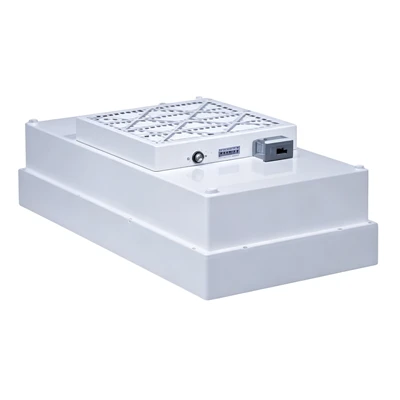
Now, how do these industrial dust collectors work, and what sets them apart from consumer or small-shop models? Unlike basic vacuums that use low-efficiency filters and rely on suction to pull debris off surfaces, industrial concrete dust collectors are purpose-built with a multi-stage filtration system tailored to capture even the smallest concrete particles. The process starts with a pre-separator, which uses centrifugal force to knock out large concrete chunks and heavy debris before it even reaches the main filter. This pre-separator is critical for reducing strain on the filter, extending its life, and preventing clogging, which is a common failure point in low-end models. Next comes the primary filter, usually a HEPA (High-Efficiency Particulate Air) filter, which is rated to capture 99.97% of particles 0.3 microns and larger— perfect for crystalline silica, which typically ranges from 0.5 to 10 microns. For even more sensitive applications, many of the units we supply also include an optional ULPA (Ultra-Low Particulate Air) filter, which captures 99.999% of particles down to 0.12 microns, making them suitable for enclosed industrial spaces or projects near occupied buildings. Most industrial models also have an automatic filter cleaning system, called a shaker mechanism or pulse-jet cleaning, that taps the filter cartridges every few minutes to dislodge built-up dust, so you don’t have to shut down the unit manually to clean it. This is a game-changer for large construction jobs that run 12+ hours a day, as it eliminates downtime caused by filter maintenance.
There are two main types of industrial dust collectors for concrete dust, and choosing the right one depends on the size of your jobsite and the type of work you’re doing. The first is portable dust collectors, which are mounted on wheels or a skid and designed for small to medium jobs: single-room concrete grinding, countertop polishing, or small demolition projects. These units usually have a CFM (Cubic Feet per Minute) rating between 500 and 1500, which is enough to pull dust from a single grinder or saw, and they’re compact enough to move between jobsites easily. The second type is stationary, central dust collection systems, which are installed for large-scale projects: highway concrete repair, commercial building demolition, or industrial concrete processing plants. These systems have CFM ratings upwards of 10,000, and they’re connected to multiple tools via a network of ducts running throughout the jobsite. Central systems are more expensive to install upfront, but they offer far better dust containment for large teams, reduce noise on the jobsite, and can be customized with additional features like explosion suppression (critical for sites where concrete is mixed with flammable adhesives or solvents) or odor control filters.
I’ve seen a lot of customers over the years make the mistake of buying the cheapest dust collector they can find, only to run into problems a week later. Last year, a residential concrete contractor came to me after two low-cost units he’d rented for a basement floor grind burned out in 3 days, and he’d already had two workers test positive for silica exposure. The issue? The cheap units only had a 1-micron filter, which can’t trap crystalline silica particles smaller than 1 micron, and they didn’t have a pre-separator, so fine dust clogged the filter in hours. After testing a portable industrial dust collector with a HEPA filter and 1200 CFM rating, he was able to run his 8-hour grind without a single filter change, and his workers’ exposure levels dropped below OSHA limits by 95%. That’s the value of a purpose-built system: it’s not just about collecting dust, it’s about reliability, compliance, and protecting your team.
Another key factor to look for in an industrial concrete dust collector is airflow and suction power, measured in CFM, but it’s not the only number that matters. A lot of suppliers will advertise high CFM, but if the static pressure (the ability of the unit to pull dust through ducts or tools) is low, the CFM is meaningless. For concrete dust, you need a unit with enough static pressure to pull dust from the tool’s shroud— the enclosing that fits around concrete grinders, saws, and drills— because that’s where 90% of dust escapes. If the static pressure is too low, the shroud won’t pull enough airflow, and dust will leak out into the air. For reference, a 7-amp concrete grinder requires at least 600 CFM of suction, and a 10-amp grinder needs 1000 CFM. If you’re running multiple tools, you’ll need a central system with higher CFM, sized to account for any duct friction loss in your setup.
Maintenance is another big difference between industrial concrete dust collectors and low-end alternatives. A good industrial unit is designed to minimize downtime, with easy-to-replace filters, simple shaker systems, and accessible pre-separators for emptying debris. We include a 12-month filter replacement kit with every unit we supply, and our service team is on call 24/7 to help with any issues, because we know a broken dust collector on a construction site can cost thousands of dollars in delayed labor or fines. For long-term use, industrial systems will also have a longer lifespan: a well-maintained portable unit can last 10 years or more, compared to 1 to 2 years for a cheap shop vac repurposed for dust collection.
It’s also important to note that using an industrial dust collector isn’t just a good idea for worker health—it’s a legal requirement in most regions. In the U.S., OSHA’s Crystalline Silica Rule mandates that employers must provide engineering controls (like dust collectors) to reduce exposure levels, instead of relying on respirators alone, for all construction and industrial work involving concrete dust. Fines for non-compliance can range from $15,625 to $156,250 per serious violation, and in 2023 alone, OSHA issued over $1.2 million in fines to construction companies for inadequate dust controls. In the EU, the Health and Safety Executive (HSE) has similar regulations, requiring employers to use best available dust control technologies, which almost always include industrial dust collectors. For contractors, installing a high-quality dust collector is not just an investment in safety—it’s an investment in avoiding costly penalties and keeping your business running.
If you’re still unsure which industrial dust collector is right for your needs, here’s a quick checklist to guide you. First, assess your jobsite size: are you working on small residential projects, or large commercial demolition? Second, calculate the number and type of tools you’re running: grinders, saws, drills, or multiple tools at once? Third, check your local regulatory requirements to make sure the unit meets OSHA or HSE standards. If you’re working on jobs that serve government clients, you’ll also need to make sure the unit is NSF (National Sanitation Foundation) or ANSI (American National Standards Institute) certified, which ensures it meets strict performance standards for dust capture.
Over the years, I’ve worked with every type of customer: small residential contractors, large industrial plants, bridge construction teams, and even countertop fabricators. Every time, the right industrial dust collector for concrete dust has transformed their jobsite. I remember a bridge repair team that used to spend 2 hours a day sweeping concrete dust, dealing with complaints from nearby residents, and adjusting their work schedules to avoid high dust levels. After installing a central dust collection system, they reduced dust emissions by 98%, finished their project 3 days early, and eliminated all complaints. For them, the dust collector didn’t just fix a problem—it made their work safer, more efficient, and more profitable.

If you’re ready to invest in a solution that protects your team, keeps you compliant, and makes your jobsite run smoother, we’re here to help. We’ve supplied industrial dust collectors to thousands of customers across the construction, manufacturing, and demolition industries, and we can help you size a system for your specific needs, no matter the project size. Don’t wait until OSHA shows up or a worker gets sick to address your concrete dust problem. Connect with our team today to discuss your requirements, get a custom quote, and learn how we can help you find the right industrial dust collector for concrete dust that fits your budget and your jobsite.
Cleanroom Air Filters References:
- Occupational Safety and Health Administration. (2022). Crystalline Silica Rule: Compliance Assistance for Construction. U.S. Department of Labor.
- Health and Safety Executive. (2021). Controlling Exposure to Crystalline Silica in Construction. UK HSE.
- National Institute for Occupational Safety and Health. (2020). Health Effects of Occupational Exposure to Crystalline Silica. CDC.
- Construction Safety Association of Ontario. (2023). Dust Control Best Practices for Concrete Grinding and Cutting. CSAO.
Jiangsu Renhe Energy Saving Technology Co., Ltd.
As one of the most professional industrial dust collectors manufacturers and suppliers in China, we also accept customized order. We warmly welcome you to wholesale durable industrial dust collectors in stock here from our factory. If you have any enquiry about quotation, please feel free to email us.
Address: No.358 Nanyuan Road, Tangqiao Town, Zhangjiagang City
E-mail: info@rhfilter.com
WebSite: https://www.rhccafenv.com/
