Hey everyone, if you’ve ever browsed decking materials for a backyard refresh, you’ve probably stumbled across WPC decking—short for wood-plastic composite, right? And chances are, you’ve wondered something like, “Wait, how heavy is this stuff anyway? Does it even matter for my project?” As a WPC decking supplier who’s been in this game for over 10 years, I get that question all the time. People are shocked when I don’t give them a straight number, but that’s kind of the thing about WPC: its weight isn’t one-size-fits-all. Let me break this down like I would for a customer standing in our warehouse, squinting at a stack of planks. WPC Decking
First, let’s start with the basics. WPC is made by mixing wood fiber (usually sawdust from pine or fir) with plastic (HDPE, mostly, from recycled milk jugs and plastic bags—we’re big on that sustainability angle, fyi) plus a handful of additives like UV stabilizers, mold inhibitors, and bonding agents. The ratio of wood to plastic is the biggest driver of its weight. Most of the standard planks we supply right now are around a 50/50 split, but some manufacturers crank up the wood content (that makes it feel more “wood-like” but way heavier) or add more plastic (lighter, more flexible, but can get a little squishy under pressure). We stick to 55% wood and 45% plastic for our core line— it’s the sweet spot we tested back in 2018, and it’s worked for every project from small patios to multi-level commercial decks.
Now, let’s get specific with actual numbers, no vague stuff. Our standard 16-foot planks (that’s the most popular length, by the way) weigh right around 50 pounds each. Wait, let’s do the math: that’s roughly 3.125 pounds per linear foot. If you’re looking at shorter planks, say 12 feet? That’s 37.5 pounds each. Longer 20-foot ones? About 62.5 pounds. But hold on— that’s just our standard line. If you go for our heavy-duty commercial grade, which is made for high-traffic areas like hotel pools or apartment balconies, we upped the wood content a bit to 60%, so a 16-foot plank jumps to around 55 pounds. And our lightweight line, which is great for rooftop decks where weight load is a big concern? That’s only 42 pounds for a 16-foot plank— yeah, that’s almost 10 pounds lighter, and it doesn’t sacrifice durability, promise.
But wait a second— weight isn’t just about how much a single plank feels when you heft it. That’s a common mistake customers make: they focus on individual plank weight, but they need to think about total load for their project. Like, if you’re building a rooftop deck, your building’s structural engineer will have a max weight limit (usually around 50 pounds per square foot for residential, sometimes less for rooftops). Let’s do a quick example: a 10×10 foot deck is 100 square feet. Using our standard 3.125 lbs per linear foot, how many planks do you need? Let’s say you install them at 1-foot gaps— that’s 11 planks across the 10-foot width, each 10 feet long (cut to fit, so we round for ease). That’s 11 planks, each 31.25 lbs, so total decking weight is around 343.75 pounds. That’s nothing compared to the structural space, right? But if you were using solid wood (pressure-treated pine), that same 10-foot plank would be around 70 pounds— way heavier. We get a lot of rooftop clients who used to work with solid wood and switched to WPC because they avoided having to reinforce their entire roof structure. That’s a huge win.
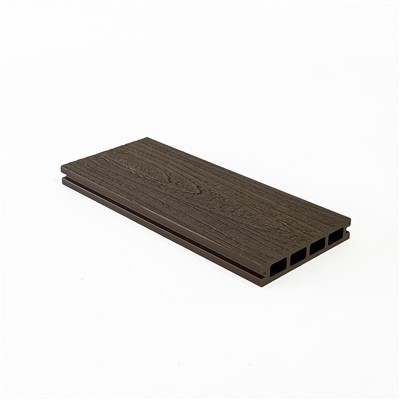
Another thing that affects weight is the profile of the plank. We carry a few different profiles: solid, hollow, and capped. Hollow planks are lighter, obviously— they have a rectangular channel running through the center to cut down on material use (and save you money, too). Our hollow 16-foot planks are only 40 pounds each, compared to 50 for solid. But hollow isn’t for everyone— if you want something that won’t flex under big patio furniture or a group of people (like for a deck around a hot tub), solid is the way to go. Capped WPC is another variant: that’s when we add a thin outer layer of solid plastic to the planks to make them more stain-resistant and scratch-proof. The cap only adds about 5% to the total weight, so our capped 16-foot planks are around 52.5 pounds each— not a big difference, but worth noting if you’re super particular about that.
Wait, let’s talk about the myth that WPC is heavier than traditional wood. A lot of people come in saying, “Is WPC heavier than cedar?” No, way. A 16-foot cedar plank weighs around 35 pounds— that’s 15 pounds lighter than our standard solid WPC, but cedar is way more prone to rotting, warping, and needing to be sealed every year. Pressure-treated pine, like I mentioned earlier, is way heavier— 16-foot is 70 pounds, as I said, and it can leach chemicals into soil, which is a turn-off for many homeowners. Even composite decks that are made by other big brands— I’m not here to badmouth them, but some of their lower-end stuff is super heavy because they use way more wood and less plastic, making it prone to swelling when it gets wet. Our WPC doesn’t swell, by the way— that’s a big plus. Rain, snow, spilled soda? Doesn’t change the weight at all, no expansion or shrinkage. That’s why we use it for pool decks so often— no slipping, no warping when the sun beats down on it.
Now, why does this weight matter beyond hefting a plank? Let’s get practical. First, installation. If you’re doing a DIY deck, you need to think about how easy the planks are to lift. Our 50-pound solid planks are manageable for two people— no need for a crane or anything. The hollow ones, at 40 pounds, are even easier, you can probably carry one by yourself if you’re not a total beginner. If you go for a super heavy WPC (some no-name brands make planks that are 60 pounds for 16 feet), that’s a pain for DIYers, and it also means you need stronger, heavier-duty hidden fasteners to hold them down. We use stainless steel fasteners for all our lines, but even the lightweight ones work with standard hidden clips because they’re not so heavy that they’ll pull loose.
Then there’s transportation. If you’re buying 50 planks for a big deck, that’s 2,500 pounds for our standard line— a regular pickup truck can handle that, no problem. If you went with a heavier competitor’s line, that same order would be 3,000 pounds, which might be over your truck’s payload limit, forcing you to rent a trailer or make two trips. That adds cost and time, so that weight number is more than just a random stat—it affects your bottom line.
Wait, let’s address a common concern I hear: “If it’s lighter, is it less durable?” Nope, like I said earlier, our lightweight line is only lighter because it’s optimized with a better plastic blend, not because it’s thinner or weaker. We load test all our planks to 1,000 pounds per linear foot— that’s like having a small car parked on a single plank, and it doesn’t bend or crack. I’ve seen customers test that themselves, setting cinder blocks on a plank, and they’re shocked when it holds up. The weight difference comes from the mix of materials, not the strength.
I should also mention that we test every batch of planks for weight consistency. No one wants to buy 10 planks that are 50 pounds each, and the 11th is 45 pounds— that’s uneven, and it messes up the spacing when you install them. We have a warehouse team that weighs every pallet of planks before it ships, so you know exactly what you’re getting. That’s part of why our customers keep coming back— we don’t cut corners on quality control.
Let me give you a real example of a recent project to put this all in perspective. We worked with a family in Austin last month who was building a rooftop deck for their vacation home. They were worried about weight because their building’s engineer said max load was 40 pounds per square foot. They initially looked at solid cedar, but when we told them the total weight would be over 4,000 pounds for their 12×16 deck, they were nervous. We recommended our lightweight WPC line. Let’s calculate that: their planks were 12 feet long, 42 pounds each. Their deck was 12×16 = 192 square feet. They used 17 planks (cut to fit the 16-foot width), so 17 x 42 = 714 pounds total decking weight. That’s nothing compared to the load of the building itself, so they didn’t need to do any structural reinforcement. They saved thousands of dollars on construction, and the deck’s held up through 100-degree Texas summers and random thunderstorms— no warping, no fading, no staining. They texted me last week saying their grandkids are already using it for summer barbecues. That’s the kind of win we love.
Another project: a commercial dog park in Chicago. They needed a deck around a large play area to keep the dogs off the mud and snow. They went with our heavy-duty WPC line because it gets a ton of traffic, plus it’s non-slip, so no one gets hurt when it’s icy. The planks were 16 feet, 55 pounds each. They used 22 planks for a 10×35 area, so total decking weight was 1,210 pounds. That’s manageable for the installation crew, and the heavy-duty profile means even with 20 dogs running back and forth, the planks don’t flex or shift. They’ve had it for a year now, and there’s not a single scratch or chip.
Now, let’s clear up some confusion. Sometimes people mix up WPC decking weight with the weight of the finished deck. Remember, the total deck weight isn’t just the planks— it’s also the substructure: the joists, the fasteners, the hidden clips, maybe even the foam underlayment if you want a softer feel. Our planks make up most of the deck’s weight, but the substructure is a smaller part, usually around 20-25% of the total. But when people ask “what’s the weight of WPC decking?” they’re almost always referring to the planks themselves, so that’s what we focused on here.
Wait, also, environmental factors? Do WPC planks get heavier when wet? A lot of people ask that. The short answer: barely. The plastic in WPC is waterproof, so it doesn’t absorb water like real wood. The wood fiber is sealed in the plastic matrix, so it only picks up a tiny bit of moisture— like 1% max, even if it’s submerged for hours. So that 50-pound plank only becomes 50.5 pounds when it’s fully wet. Compare that to solid wood, which can absorb 20% or more of its weight in water— a 50-pound cedar plank becomes 60 pounds when soaked. That’s a huge difference, especially for pool decks or areas that get a lot of rain. No heavy, waterlogged planks to worry about.
So, to recap the key takeaways, no more confusion:
- Our standard 50/50 wood-plastic mix planks: ~3.125 lbs per linear foot, 50 lbs for 16ft
- Lightweight line (rooftops, low structural load): ~2.625 lbs per linear foot, 42 lbs for 16ft
- Heavy-duty line (high traffic, commercial): ~3.4375 lbs per linear foot, 55 lbs for 16ft
- Hollow planks are 10 lbs lighter than solid of the same length and profile
- Weight doesn’t affect durability (we load test every single one)
- It affects installation ease, transportation costs, and structural load limits
At the end of the day, the weight of WPC decking isn’t a random number to memorize—it’s a spec that’s tailored to your project. If you’re a DIYer doing a small backyard deck, lightweight or standard is perfect, easy to work with. If you’re a contractor doing a multi-level commercial deck, heavy-duty is the way to go for longevity. If you’re a homeowner with a rooftop, lightweight saves you from extra structural costs.
I always tell customers: don’t just pick the lightest or heaviest WPC you see. Think about where you’re installing it, what kind of traffic it will get, and any structural limits. If you’re still not sure, just reach out— we can walk you through your specific project, give you exact weight calculations, and even help you figure out how many planks you’ll need. We don’t push the most expensive line, we push the one that works for you.
If you’re ready to get started on your deck, or just have more questions about WPC weight, durability, or anything else, hit us up. We can send you free samples so you can heft them yourself, no obligation. Building a deck should be fun, not stressful, and knowing the basics like weight is the first step to making sure your project goes smoothly. No more guessing— we’ve got the numbers, the experience, and the WPC planks that’ll last for decades. Let’s build something great together.
Classic WPC Cladding References:
- American Society for Testing and Materials (ASTM) Standard D7031, Standard Practice for Evaluating Wood-Plastic Composite Decking Materials
- Wood Plastic Composites Association (WPCA), 2023 Industry Report on WPC Material Properties and Weight Specifications
- International Building Code (IBC), 2021, Structural Load Requirements for Decks and Rooftop Walkways
- University of Florida IFAS Extension, “Wood-Plastic Composite Decking: Properties and Installation” (2022)
Zhejiang Timber Biology New Material Co., Ltd.
As one of the most professional wpc decking manufacturers and suppliers in China, we’re featured by quality products and good service. Please rest assured to wholesale custom made wpc decking at competitive price from our factory.
Address: No. 192, Longshan Road, Zhongguan Town, Deqing County, Huzhou City, Zhejiang Province
E-mail: info@tongrui.cc
WebSite: https://www.utimberwpc.com/
