If you’ve ever worked in a busy auto shop, a construction site, a dedicated home garage, or even a rapidly growing maintenance facility, you know the value of a tool cart that works with you, not against you. As a modular tool cart supplier, I spend almost every day getting emails, calls, and in-person questions about how much space these carts actually need—because too often, teams waste valuable square footage on oversized, inflexible tool storage that either crams all their gear into a cramped corner or leaves dead space unused. Let’s cut through the guesswork: today, we’re breaking down the science and real-world use cases behind the minimum space required for a modular tool cart, no corporate jargon or one-size-fits-all fluff. Modular Tool Cart

First, let’s ground this in what “modular” actually means here. Unlike a big, fixed-chest tool box that’s 48 inches wide, 24 inches deep, and 36 inches tall (you know the one—hard to move, impossible to reconfigure), our modular carts are built to adapt. Each core module is roughly 20 inches wide, 24 inches deep, and can be stacked, pulled out, or paired with add-ons like side trays, power cord hangers, or small parts bins. That adaptability is the key to figuring out minimum space—because it means we don’t force customers to take a 4-foot wide hunk of metal if they only need space for a socket set, a torque wrench, and a few specialty hand tools.
Now, let’s talk about the non-negotiables when calculating minimum space. I’ve seen teams try to cram a cart into a 22-inch wide hallway and immediately run into two problems: first, they can’t open the drawers all the way, and second, they can’t roll the cart out to where the work is. For context, every modular cart module has a standard drawer opening radius—drawers need at least 6 inches of clearance in front of them to fully extend without hitting walls, workbenches, or other equipment. And then there’s maneuverability: even a small 20-inch wide cart needs at least 2 inches of clearance on each side to roll smoothly, no scraping the wheels or catching on baseboards.
Let’s do the math for the smallest common modular cart setup, which is the go-to for home garages, small mobile technicians, or craft spaces. A single core module (the base unit, no add-ons) is 20 inches wide, 24 inches deep, 35 inches tall. Add 6 inches of clearance for drawer access on the front, 2 inches on each side for rolling, and 2 inches on the back to account for wall space and power cords (if you’re plugging in any small tools or chargers). That adds up to: width = 20 + 2 + 2 + 6 = 30 inches; depth = 24 + 2 (back clearance) = 26 inches; height can stay the same at 35 inches, unless you’re stacking, in which case you just add module heights. Wait, but hold on—what if you don’t need the drawer access all the time? I had a customer last year, a custom woodworker with a narrow 28-inch wide work nook, who told me he only opens the top drawer when he’s reaching for chisels, and leaves the lower drawers closed most of the time for sandpaper and clamps. He got away with a 28-inch wide space, skipping some of the front clearance because he added a side pull-out table for his most-used tools that only opens when he needs it. But that’s a niche case, not the minimum we’d recommend as a standard—because if you’re cramming for occasional use, you risk bending a drawer slide or scraping a wheel when you do need full access.
Now, let’s scale this up for the most common use case: a shop bay, maintenance area, or mid-sized home garage. The most popular modular cart setup for these spaces is three core modules stacked vertically: the bottom is a deep drawer for power tools like drills and saws, the middle has smaller drawers for sockets and wrenches, and the top is a wide pull-out tray for active work. That setup is 20 inches wide, 72 inches tall (3 modules at 24 inches each), still 24 inches deep. For this, the minimum space we recommend is 36 inches wide, 30 inches deep, and 78 inches tall. Why? Because if you have a few add-ons—like a side tray for tape measures and pens, or a small parts bin on the top—you need that extra 6 inches of front space to pull the tray out, and 2 inches on each side if you ever need to move it across the shop. I had a shop foreman in Detroit hit this exact number last quarter; he had a 36-inch wide gap between two workbenches that he thought was too small for any tool cart, but once he swapped his old fixed chest for a modular three-module setup, he had a perfect fit and even had room to spare for a mobile parts bin.
Wait, what about mobile use? A lot of our customers are mobile technicians—plumbers, electricians, HVAC techs—who need to roll their cart between job sites and work in tight, cramped vans or truck beds. For that, the minimum space shrinks a bit, but with a tweak. A mobile modular setup is usually a compact 20-inch wide base module with a fold-down side shelf, so total width when folded is still 20 inches, total width when extended is 30 inches. For truck beds or van storage, the minimum interior space is 22 inches wide and 60 inches long—because you can tilt the cart on its wheels to slide it into tighter spots, or use the fold-down shelf to fit in spaces that are slightly narrower than standard. I’ve had electricians tell me they fit these into the back of a small cargo van that only has 24 inches of interior width, no problem, because the modular design lets them remove non-essential add-ons when they’re doing small jobs.
Now, let’s bust a common myth I hear all the time: people think modular carts need more space because you can add on. That’s backwards. Fixed chests are big, and if you need more space, you have to buy a whole new chest. Modular carts let you start with the minimum space, then add on as you grow. So if you start with a 30-inch wide cart in a small home garage and then move to a larger shop, you can add another module to the side (instead of replacing the whole cart) to get more storage, and that extra module only adds 20 inches to your total footprint, not 4 feet like a fixed chest would. That flexibility is why so many of our repeat customers are growing businesses—they don’t have to rearrange their entire shop when they need more tool space.
I’ve also learned a lot from customers who work in even tighter spaces, like apartment workshops or kiosk maintenance areas. Last year, a customer who maintains airport information kiosks needed a cart that fit into a 24-inch wide closet-sized space. We worked with him to build a custom compact module: a slim 18-inch wide base, no side tray, with drawers that open outward instead of forward (a simple modular tweak that cuts down on clearance needs). That setup only needs 24 inches of width, 26 inches of depth, and 36 inches of height—perfect for his needs. But that’s a custom solution, not the standard minimum, because it’s tailored to a very specific use case where he never needs to move the cart around, just open the drawers and pull out small tools.
So putting all this together, what’s the real minimum space for a modular tool cart? For the standard, everyday use case—home garage, small shop, mobile tech—the non-negotiable minimum is 30 inches (76.2 cm) wide, 26 inches (66 cm) deep, and 40 inches (101.6 cm) tall for a single module. For stacked or setups with add-ons, bump that to 36 inches (91.4 cm) wide, 30 inches (76.2 cm) deep, and 78 inches (198 cm) tall. For custom ultra-tight spaces, you can go as small as 24 inches (61 cm) wide with specialized drawer and add-on designs, but that requires adjusting how you use the cart (no frequent repositioning, only open front drawers).
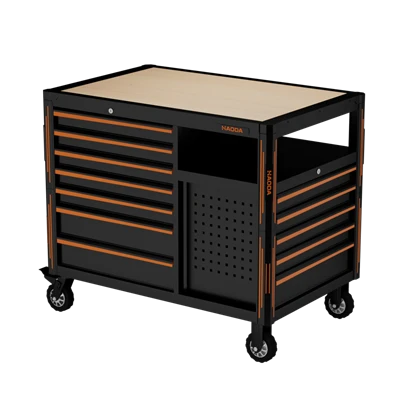
At the end of the day, the goal of a tool cart isn’t to waste space—it’s to organize tools so you can work faster, without tripping over a big box or scraping a cart against a wall. As a modular tool cart supplier, that’s what I focus on: building products that adapt to your space, not the other way around. If you’re trying to figure out if a modular cart fits your specific space, or you’re looking to upgrade your storage without rearranging your entire workspace, I’m here to help. Get in touch to discuss your space, your tools, and how we can build a setup that works for you. Don’t settle for one-size-fits-all tool storage that wastes your most valuable resource—space.
Tool Box References:
- Automotive Aftermarket Suppliers Association. "2023 Shop Equipment & Storage Best Practices."
- International Organization for Standardization (ISO). "Tool Storage and Handling Equipment for Industrial Workspaces."
- Small Business Administration. "Space Optimization for Small Workshops and Mobile Operations."
- National Tool Association. "Modular Storage Solutions: Adaptability and Footprint Efficiency."
Zhejiang Jinhoda Industrial & Trading Co., Ltd.
Zhejiang Jinhoda Industrial & Trading Co., Ltd. is one of the most professional modular tool cart manufacturers and suppliers in China. Please rest assured to wholesale high quality modular tool cart with ISO certification from our factory. Welcome to contact us for customized service and OEM service.
Address: No.12, Shanyan Road, Hutown, Jinyun County, Lishui City, Zhejiang Province,China
E-mail: Sales18@cnjinhaoda.com
WebSite: https://www.haodacabinet.com/
