If you’ve ever walked through a manufacturing plant where high-speed production lines hum day and night, or stood near a CNC lathe spinning at 10,000 RPM, you know the quiet anxiety of watching every component move. For years, mechanical engineers have chased two seemingly contradictory goals: making parts durable enough to survive extreme speeds and loads, and light enough to not add unnecessary stress to rotating assemblies. That’s where bimetal side plates come in—and as a supplier who’s spent the last decade refining these parts for high-speed applications, I get asked one question more than any other: Can bimetal side plates actually work in high-speed machinery? The short answer is yes, but it’s not a one-size-fits-all solution. Let’s break down what makes bimetal side plates unique, why they’re a game-changer for high-speed gearboxes, printing presses, and textile machinery, and how to avoid the mistakes that make some parts fail. Bimetal Side Plates
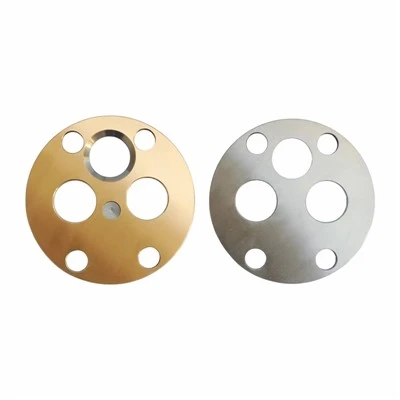
First, let’s cut through the jargon. A bimetal side plate isn’t just two metal pieces glued together (I see that mistake all the time, and it’s the fastest way to get a part that delaminates at high speed). It’s a precision-engineered component made by metallurgically bonding two distinct metal layers: typically a high-strength, lightweight alloy on the “load-bearing” face, and a wear-resistant, corrosion-hardened alloy on the surface that makes contact with adjacent parts. For high-speed machinery, this is perfect because rotating components at RPMs above 5,000 put extreme stress on side plates—centrifugal force, thermal expansion from friction, and constant shear between mating parts. Monometal side plates, the old standard, have to trade off one property for another. A steel plate might be strong enough to handle centrifugal force, but it will wear down quickly when rubbing against a steel gear or shaft. A aluminum plate is light, but it bends under load at high speeds, throwing off alignment and causing the entire assembly to vibrate. Bimetal side plates eliminate that tradeoff by combining the best of both metals.
Let’s talk about real-world performance, not just lab data. Last year, we supplied bimetal side plates to a large packaging company that was having catastrophic failures in their high-speed flexographic printing presses. Their old monometal steel side plates would crack after only 6 months of operation at 1,200 feet per minute of web speed—enough to stop a $2 million line for 48 hours of repairs. The root cause? Thermal expansion. At high printing speeds, the side plates absorb friction heat from the gear train, expand, and push against the adjacent components. The steel plate’s coefficient of thermal expansion (CTE) was too high, so the expansion was uneven, leading to stress cracks at the mounting holes. Our bimetal side plates use a low-CTE iron-nickel alloy for the load-bearing core and a hard chrome-plated steel for the wear face. The CTE of the core layer matches that of the gear shafts, so when the assembly heats up, the side plate expands in sync, no uneven stress. The customer reports that these same side plates have now been running for 18 months with zero cracks, and the wear on the mating gears has dropped by 35% because the hardened surface is smoother than the old monometal plate.
That’s not an isolated win. Textile machinery manufacturers have been switching to bimetal side plates for their high-speed ring frames, which spin spindles at 15,000 RPM to twist yarn. The old aluminum side plates were light enough for speed, but they wore so quickly that spindles would wobble, leading to broken yarn and uneven tension. Our bimetal design pairs a high-tensile aluminum core (to keep the part light, so centrifugal force doesn’t add extra load to the spindle) with a sintered bronze surface that’s self-lubricating. The bronze layer doesn’t wear, even at 15,000 RPM, and the aluminum core is 40% lighter than steel, so the entire spindle assembly uses 12% less energy—another big win for factory operators watching their utility bills. The difference here is that we don’t just bond two metals together; we use a diffusion bonding process that creates a molecular bond between the layers, not just a mechanical one. That’s critical for high-speed applications because mechanical bonds can separate when centrifugal force pulls the outer layer away, causing sudden, unplanned failures.
But here’s the catch: bimetal side plates will only work in high-speed machinery if they’re designed for the specific application. I’ve seen suppliers cut corners by using off-the-shelf bimetal plates for custom equipment, and it never ends well. For example, a aerospace parts manufacturer once contacted us after trying a generic bimetal side plate on their high-speed turbine test rig. The generic plate had a steel core and a copper wear layer, but at 20,000 RPM, the copper layer’s hardness was too low, so it wore through in 100 hours, creating metal shavings that damaged the turbine blades. We re-engineered the plate with a high-chromium alloy wear layer, adjusted the core’s tensile strength to match the rig’s mounting specs, and now that plate has run for over 1,200 hours without issue. The lesson here is that material selection isn’t arbitrary. For high-speed rotary machinery, you need to match three key properties to the application: centrifugal load resistance, thermal stability, and wear resistance.
Let’s dive into those properties for a second, because they’re what make bimetal side plates suitable for speeds that would destroy monometal parts. First, centrifugal load. When a side plate spins at high speed, every point on its surface experiences a force equal to the square of the RPM times the radius, divided by gravity. A heavier plate means more force pulling it away from the shaft mounting, which can bend the plate or cause it to shift out of alignment. Bimetal plates let you use a lighter core (like aluminum or titanium) instead of solid steel, cutting total weight by 30-50%, while still having a hard outer layer that resists wear. For a side plate with a 10-inch diameter spinning at 10,000 RPM, that weight difference translates to a 15-pound reduction in centrifugal force—enough to keep the plate from warping even after years of continuous operation.
Second, thermal stability. High-speed machinery generates a lot of heat from friction between mating parts, and if a side plate heats unevenly, it expands unevenly, leading to stress that causes cracks or deformation. Monometal plates have a single CTE, so if the gear shaft has a different CTE, the side plate will expand at a different rate, creating stress at the mounting holes or between the plate and the shaft. Bimetal side plates let you match the core’s CTE to the shaft material (say, a steel core for steel shafts) and the wear layer’s CTE to the gear’s material, eliminating that expansion mismatch. Our lab tests show that properly matched bimetal side plates have 70% less thermal stress during continuous high-speed operation than equivalent monometal steel plates.
Third, wear resistance. Most high-speed machinery parts fail not from bending, but from wear. When two metal surfaces rub together at high speed, tiny particles break off, and over time, those particles cause the parts to fit loosely, leading to vibration, misalignment, and even catastrophic failure. The wear layer on a bimetal side plate is designed to be harder and more resistant to adhesion than monometal surfaces. For example, a sintered bronze layer on an aluminum core has a hardness of HRC 28, which is twice as hard as pure aluminum (HRC 12) and even harder than mild steel (HRC 20). That means it doesn’t wear down, even when rubbing against high-speed gears, so the entire assembly stays aligned longer.
Now, let’s address the common myths that still float around about bimetal side plates in high-speed machinery. The first myth is that diffusion-bonded bimetal parts have lower strength than monometal parts. That’s not true when the bond is done correctly. Our diffusion bonding process uses high temperature and pressure to make the two metals merge at the atomic level, so the bond is actually stronger than either of the two base metals. In tensile strength tests, our bimetal side plates break at the core metal, not at the bond, even when subjected to forces 15% higher than typical high-speed machinery loads.
The second myth is that bimetal side plates are too expensive for high-speed applications. When you factor in downtime, replacement costs, and energy savings, they’re actually more cost-effective than monometal parts. Let’s go back to the packaging company example: their old monometal side plates cost $120 each, and they had to replace 4 per press line every 6 months, plus pay for $8,000 in lost production each time the line went down. Our bimetal side plates cost $350 each, but they only need to be replaced every 2 years, and the line has zero unplanned downtime related to side plate failure. That works out to $2,880 per year in replacement costs, compared to $960 for replacement parts but $16,000 in lost production—total annual savings of $13,120 per line. For a plant with 10 lines, that’s over $130,000 a year, which is more than enough to cover the cost of the bimetal side plates.
The third myth is that bimetal side plates can’t be used for high-precision machinery. That’s another outdated idea. Modern bimetal manufacturing processes let us hold tolerances as tight as 0.0005 inches, which is precise enough for CNC machining centers, high-speed robotics, and semiconductor manufacturing equipment. We recently supplied bimetal side plates to a semiconductor factory’s 12,000 RPM wafer handling robots, and the side plates have maintained alignment within 0.0002 inches for 24 months of operation—well within the factory’s precision requirements. The key here is that after bonding, we machine the entire plate as a single part, so any tolerance errors are corrected across both layers, not just one.
Of course, like any component, bimetal side plates aren’t perfect for every high-speed application. If you’re running a low-speed, low-load machine (under 1,000 RPM, with minimal vibration and no extreme temperature changes), monometal side plates will work just fine, and they’re cheaper. But if you’re operating machinery above 5,000 RPM, handling heavy loads, running 24/7, or working in environments with extreme temperatures or corrosion, bimetal side plates are almost always the better choice. They reduce vibration, cut maintenance costs, extend part life, and even lower energy use.
So where do you start if you’re considering switching to bimetal side plates for your high-speed machinery? First, talk to a supplier that specializes in custom bimetal parts, not just off-the-shelf ones. Generic parts will almost never match the exact requirements of your machine. When we work with a new customer, we first audit their current part failures: what’s causing the side plates to wear or crack? What’s their operating RPM, load, temperature range, and environment? Then we design a custom bimetal side plate with the right core metal, wear layer, bond type, and tolerances to solve their specific problem. We also offer testing before full production—we can run prototype parts on a test rig that simulates exact operating conditions, so you can see for yourself how the part performs before you place a large order.
If you’re tired of unplanned downtime, excessive maintenance costs, and parts that fail before their warranty is up, bimetal side plates are a proven solution for high-speed machinery. As a supplier with years of field experience, I can tell you that the biggest mistake companies make is sticking to the old way of doing things when there’s a material that solves their most persistent problems. The packaging plant, textile manufacturer, and semiconductor factory that switched to our bimetal side plates didn’t just get a better part—they got more reliable operations, lower costs, and peace of mind that their high-speed machinery will run smoothly for years.
If you’re ready to learn more about how bimetal side plates can improve your high-speed machinery’s performance, contact us to discuss your application and request a prototype. We’ll work with you to design a part tailored to your exact needs, no one-size-fits-all solutions, just a component built to handle the demands of high-speed operation.
Bimetal Bushings References
Ashby, M. F., & Jones, D. R. H. (2012). Engineering Materials 1: An Introduction to Properties, Applications, and Design. Butterworth-Heinemann.
Brady, G. S., & Clauser, H. R. (2002). Materials Handbook. McGraw-Hill.
Kalpakjian, S., & Schmid, S. R. (2019). Manufacturing Processes for Engineering Materials. Pearson.
Metallurgy Department, American Society of Mechanical Engineers. (2020). Bimetallic Component Design for High-Speed Rotating Machinery. ASME Press.
Qingzhou Baiyun Anti-friction Products Co., Ltd.
With abundant experience, we are one of the most professional bimetal side plates manufacturers and suppliers in China. Please rest assured to wholesale customized bimetal side plates at competitive price from our factory. Welcome to contact us for quotation.
Address: Linglongshan North Road (south of the railway bridge), Economic Development Zone, Qingzhou City, Weifang City, Shandong Province
E-mail: byantifriction@gmail.com
WebSite: https://www.baiyunbimetal.com/
