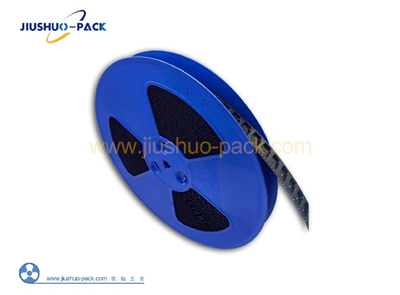
If you’ve ever worked in surface mount technology (SMT) or electronics manufacturing, you’ve probably never stopped to think about the thin, lightweight tape that carries those tiny resistors, capacitors, or ICs through pick-and-place machines. But as someone who’s spent 12 years as a paper carrier tape supplier—starting in a tiny workshop in the Midwest before growing into a reliable partner for 30+ electronics factories across North America and Europe—I can tell you: this tape is not just paper and glue. It’s the backbone of consistent SMT assembly, and its quality standards aren’t arbitrary. They’re built to keep your production line running, reduce waste, and protect the components you pour thousands into. Paper Carrier Tape
I’ve learned this lesson the hard way. Early on, I shipped a batch of tape to a customer making medical wearables—their components were so small (0201 resistors) that a single misaligned pocket meant a day of downtime. I got a frantic call at 2 a.m., drove three hours to their facility, and pulled the tape apart to find the pockets had stretched 0.2mm during assembly. That mistake cost me more than just the cost of the tape; it cost trust. Since then, I’ve poured every conversation with customers, every test, and every iteration into getting the quality standards right. Today, let’s walk through what makes a paper carrier tape meet real, functional standards—not just the ones on a spec sheet.
First, let’s ground this: paper carrier tape isn’t a throwaway alternative to plastic. It’s a sustainable choice—many of our clients opt for it to hit their ESG goals—so its core quality starts with the paper itself. The base material can’t be flimsy or inconsistent. For standard SMT applications, the paper needs to have a basis weight (that’s the measure of how heavy a given area is, basically) between 120 gsm and 180 gsm. Wait, I know—120 to 180 sounds like a broad range, but that’s because it’s tailored to the component size. Tiny components need thinner paper, but thicker paper isn’t better if it’s too brittle. The big test here is tensile strength: when we pull the tape lengthwise, it should withstand at least 15 N of force before breaking. If it stretches more than 5% under that pull, you’re going to have issues feeding it through the pick-and-place machine.
I test every roll I produce myself (yes, even after our third-party lab checks) because I’ve seen low-grade paper tear mid-assembly. Last year, a customer in Detroit was using a competitor’s paper tape for automotive sensors—they ended up with 2,000 failed units because the tape ripped during high-speed runs (120 components per minute, which is standard for automotive lines). The reason? Their base paper had a tensile strength of only 10 N, barely scraping by. My suppliers send us paper that’s tested for tensile strength three times before it even gets to our facility.
Next up: the pocket formation. This is where 90% of quality failures happen. The pockets, those little indentations that hold components, can’t be too big or too small. For component sizes below 0402, the pocket dimensional tolerance needs to be ±0.1mm. For larger parts (like SOIC chips), it’s ±0.2mm. But it’s not just about width and depth—shape matters too. If a pocket is oval when it should be square, the component shifts during transport. I once worked with a startup making smart watches that had to recall 500 units because a batch of my early tape had pocket walls that were too sharp; they scratched the gold-plated pins on their microchips. That’s why we use a hot-embossing process for pocket formation, not stamping—stamping can leave rough edges. Hot embossing melts the paper slightly, creating smooth, rounded walls that cradle components without scratching.
Another critical part of pocket quality: blank adhesion. The cover tape (usually a clear polyester or polypropylene film) seals the pockets so components don’t fall out. If the blank—the edge of the tape where the cover is sealed—has too much or too little adhesion, you’re in trouble. On one side, if the cover tears away from the paper, you lose components. On the other, if it’s too strong, the pick-and-place nozzle can’t peel it off quickly enough, causing missed picks. The ideal seal strength here is 0.3 N to 0.8 N per 10mm of width. We test this by pulling the cover tape off at a 180-degree angle at 300 mm/min, a speed that mimics real pick-and-place lines. I still remember when we got this wrong: a customer in Canada had their line speed drop to 60 components per minute because the cover needed too much force to peel. We adjusted our sealant composition, and they’re still with us today.
Then there’s the issue of static. Electronics hate static. It zaps microchips and kills even the most well-made components. Paper is naturally more static-prone than plastic, so that’s a huge quality hurdle. The paper needs to have a surface resistivity between 10^6 and 10^10 ohms per square—this is the anti-static range that safely dissipates static electricity without building up charge. I test this every time a new batch of paper arrives. A few years back, we got a bad batch that hit 10^12 ohms; we caught it before shipping, but it was close. If that had gone to our client, their SMT line might have destroyed thousands of $10 microchips. We also add a static-dissipative coating to the paper during manufacturing—this isn’t a cheap spray-on trick; it’s embedded deep into the paper fibers, so it doesn’t wear off even after being rolled, stored, or transported for months.
Dimension consistency across the entire roll is another standard that’s easy to overlook. If one roll is 8mm wide and the next is 8.1mm, it won’t fit the tape reel or the SMT machine’s feeders. We hold our tape to ±0.05mm in width tolerance, way stricter than the industry’s general ±0.1mm. Length is important too—customers need exactly what they order, no extra or missing. We count the number of meters per roll using a precision measuring wheel, and we label every roll with both length and serial number, so if there’s a problem down the line, we can trace it back to the exact batch.
Wait, I know a lot of suppliers skip environmental testing, but here’s the thing: paper carrier tape is often stored in warehouses or shipped in humid areas. If it absorbs too much moisture, it expands, and the pockets shift, or the tape doesn’t feed through the machine. Our paper has a moisture content between 4% and 6%—we test this with a moisture analyzer before and after each production run. We’ve shipped rolls to clients in Singapore, where humidity is over 80% year-round, and those rolls still measure 5% moisture when they arrive. That’s not luck; that’s using barrier packaging—sealed, moisture-resistant plastic bags with desiccants. I refuse to ship rolls in cardboard boxes that let moisture in, even though it costs me a little more. Last year, a client in Brazil told me a competitor’s tape had expanded so much in their rainy warehouse that it wouldn’t fit their feeders. We’ve never had that happen.
And let’s talk about sustainability, since that’s a big part of why customers choose paper over plastic these days. The quality standards here aren’t just about being “eco-friendly”—they’re about the tape performing the same as plastic, while being recyclable or compostable. Our tape is made with 100% virgin kraft paper (no recycled fiber that has inconsistent strength) and water-based adhesives, so it doesn’t have harmful chemicals. We make sure it meets ASTM D6400 standards for compostability, but we also test that it doesn’t leave residue that would contaminate components. A few years back, a client asked if our tape could handle aerospace components, which have strict purity rules. We ran it through their testing and found that our paper and adhesives had zero volatile organic compounds (VOCs)—so it passed with flying colors.
I’ve spent years refining these standards because I know what’s at stake for every one of my customers. A bad batch of tape doesn’t just mean a few extra cents in cost—it means production downtime, lost revenue, and even damage to a product’s reputation. That’s why I never cut corners: I test every batch, I work with my team to fix small issues before they become big ones, and I listen when customers tell me their specific needs. If you’re working on an SMT line, if you need paper carrier tape that’s reliable, consistent, and designed to protect your components, I’d love to talk. We can tailor the standards to your exact application—whether you’re making tiny wearables or large automotive sensors. For more details or to discuss your requirements, get in touch.
Cover Tape References:
ASTM D6400 – Standard Specification for Compostable Plastics
IPC-CF-926 – Standard for Carrier Tapes for Use in Surface Mount Technology
TAPPI T494 – Tensile Strength of Paper and Paperboard
Dongguan Jiushuo Industrial Co., Ltd.
As one of the most professional paper carrier tape manufacturers and suppliers in China, we also support customized service. Please feel free to buy high quality paper carrier tape made in China here from our factory. Contact us for more details.
Address: 11th Floor, Building 2, Chuangfu Center, Chashan Town, Dongguan City, Guangdong Province, China
E-mail: sales06@zaidaiw.com
WebSite: https://www.carriertape-pack.com/
